

Success Stories
Patients who chose the UroLift™ System procedure share personal stories of living with BPH and their treatment journeys.*
Patient Videos*
My name is Doctor. Mark Hong, and I'm a urologist. Well, BPH is a very common issue. In fact, it's the most common reason why men come in to see me. BPH, of course, is a benign or noncancerous enlargement of the prostate. So as you get older, prostate gland grows. It can cause you urination issues, such as a slow stream, getting up at night, going often, and feeling like you're not emptying yourself completely. Well, my symptoms first started when I was in my late twenties, and that was my first, dealings with, the prostate and my issues. And, I've been battling that since, you know, into my late fifties. My symptoms basically were discomfort, frequent urination, especially at night, and, an urgency to urinate. And, that was my symptoms early in my twenties and thirties and forties. And and my fifties, my symptoms changed a little bit. My symptoms had worsened to the point where, yes, it did impact my personal and family life, and even and even my professional life. Personally, I did not want to go out. I I would try and sit at home or relax and lay down. I'd lay down on the floor trying to get some relief. I did not wanna go out and be around other people. Wasn't in the mood. I felt bad, and, I lacked motivation to do anything. And and that started impacting my my professional life. Also, a common complaint is that guys feel like they're getting up often to use the bathroom. So they might be getting up twice, three times, even every hour for some guys. And then when they go to the bathroom, they feel like it's hard to urinate or it just takes them a while to empty, and they might not even feel like they have that much in their bladder when they actually pee. So it totally messes up their sleep, and then they're miserable because throughout the day, then they're tired. One of the most exciting things is something called a UroLift. It's a very minimally invasive way of opening up the prostate. The UroLift involves the placement of several implants that go into your prostate. These implants are kind of like small clips. Over the dozens of UroLifts that I've done over the last several years, I've seen a dramatic, results in terms of what we, both measure objectively and also what patients are telling me subjectively. So one of the major advantages of the UroLift is going to be its impact on sexual function. Or to put it another way, it's non impact on sexual function because it's really one of our best treatments for BPH that doesn't impact sexual function. So I stopped in and here's doctor Hong and and I explained my symptoms to me to him and he immediately began running the test and, and ruling things out. And he decided that I was a candidate for the Urolift and, and he performed that procedure. This procedure, the UroLift is as I mean, I was at my wit's end. This has given me a whole new attitude toward going on. I mean, I was miserable. I was miserable in every aspect of my life. And I just can't say enough about this procedure. The positive impact at this point it's had on me. I can't say enough for this procedure. I cannot. I have to encourage anyone that is, is having issues. Go to find you a doctor, seek out a doctor, do some research on this UroLift It is mean, what have you got to lose? I mean, what have you got to lose?
Ken W. - Arizona
My name is Corey James Blessingain. I had BPH for about ten years before I did anything. I started having those symptoms in my early 40s, late 30s, where I noticed that I would have to get up in the middle of the night to go to the bathroom. I want to say ten years. I kind of lived that life of getting up, going to the bathroom in the middle of the night, not being able to travel far because I needed to be around the bathroom, being careful of how much liquids I drank. So that's kind of my early stages of BPH. I was living in my hometown or where I grew up at, New York City, and they didn't have anything that was beneficial or that I thought I would want to do. I didn't like the invasive procedures that they were talking about. I then moved to Pennsylvania and got a new urologist. Speaking with this urologist, within a year, he introduced me to this new procedure called the UroLift. And I stepped out on what we call FAITH, and I did it. Within a week, I drove to New York, and I did not have to stop. I was able to travel and not have to pull over and I've been leakage free for a while. I became a UroLift System Ambassador because it gave me my life back and I felt that everyone should have their life and live it to the fullest. The advice I would give to men who are experiencing BPH is not to sit around and think it's going to go away. It doesn't go away on its own. Go check. Go get yourself checked out.
Corey B. - Pennsylvania
Benign prostatic hyperplasia is essentially what lay people call enlarged prostate. It's a natural process that occurs starting in our mid-40s and just occur, it gets larger as we get older. In a lot of men, it actually causes some significant annoying urinary symptoms. When I had to go, I had to go. I would wake up wet. I couldn't drive anywhere. I needed something done. I was in such a predicament with my whole life, the way it was going, having to wear a pad at night, not knowing whether I was going to wake up or whether it was going to be a problem in the morning that had to be cleaned up, whether I was going to leak. It was very embarrassing, and I prided myself very much on my ability to perform in the bedroom. That was gone. So it was kind of a slap in the face and it was very depressing. Over the years I had noticed that increasing discomfort and sometimes downright humiliation that my husband was experiencing with the symptoms that he was having. And it got to the point where it's like something needs to be done for him to put him back to where he used to be. When he came to see me, I offered him several options. Surgery wasn't much of an option for him because of the sexual side effects associated with it. He's also a very active member of the community, so I offered him UroLift and it was absolutely a perfect, perfect fit for him. I noticed results actually the same day. I thought it didn't have the urgency to go like I had before. A couple of weeks after the procedure was probably the best part of it because everything had settled in. He seemed to be healed. He seemed to be doing just fine, which improved all aspects of our life.
Larry W. - Arizona
My name is Dwight, and I live in Vista, California. Well, I spend most of my time, metal detecting and, riding by quads out at the desert. I I was getting up three to five times every night to urinate and it just wasn't happening. So, it was recommended that I would go further and either take a pill or have an operation or something to relieve my symptoms so I could get back with my regular life. BPH stands for benign prostatic hyperplasia, and in colloquial terms means a large prostate, and manifests as difficulty with urination. And that can manifest as both irritative and obstructive urinary symptoms. So BPH is one of the most prevalent disease processes that happens to men as they get older. Approximately seventy percent of men in their 70s or eighty percent of men in their 80s will have enlarged prostates and suffer from symptoms. And those symptoms can vary from very mild symptoms, very severe symptoms that affect their quality of life. That make them not want to go out, not be able to go on car rides, and not be able to function socially. Flomax was the only thing that I tried to relieve my symptoms. My neighbor said that he was on it, So I tried it for about three months and I couldn't tell any difference. So I asked Doctor. Phillips, what else is there? I mean, so he told me about the UroLift. I wanted to get back to where I could enjoy life and not have to be looking for restrooms all the time. I performed Dwight's UroLift procedure here in the office with local anesthesia and did quite well. Didn't really have any really big pain. Pain. All there was was a little bit of discomfort when they were taking the instrument and pushing it up against my bladder. And that was about it. Mean, other than that, there was was no big deal. Now I'm going back to riding my quad all day RVing and I don't have to stop along the freeway every few miles to use the bathroom. And, I would recommend UroLift.
Dwight - California
I'm Ed and I live in Scottsdale, Arizona. I work in the transportation logistics arena. I had symptoms that occurred over, I'd say the past five years or so you know they were there and I went and saw a urologist when we lived in Denver he said just keep an eye on it you have an enlarged prostate Doctor. Jaffe said you know you need to we need to do something else it's not working So Ed is one of the early patients that I treated with UroLift. And in my experience so far, I have seen patients that have done so well with UroLift that I really believe it's going to be the answer. I'm seeing much greater improvement of symptoms and of objective studies with UroLift than I can see with medications. And they are having fewer side effects. Sets itself apart from all of the other treatments because it does not have a negative impact on sexual function. Well the procedure was very quick, you know, often as an outpatient and seems like it took about an hour. I continue to improve for several months actually and it's been great ever since. Very pleased.
Ed - Arizona
Patient Blogs*
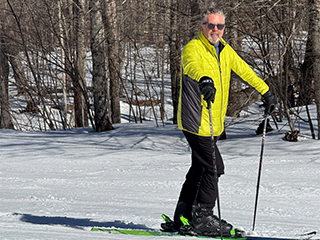
Meet Ron L.
Ron suffered in silence while his BPH symptoms caused inconvenience and embarrassment.




Your Score and More
Get the Free App
Get your detailed MyBPH report with BPH Advisor™ and learn more about treatment options. Get the app or visit BPHAdvisor.com today.

Read the BPH Blog
Check out these helpful articles on BPH and related topics.

Insurance Info
The UroLift™ procedure is covered by Medicare, national, and commercial plans.*
*when medical criteria are met

Find a Physician
Search for UroLift-trained physicians in your area.
References
*As with any medical procedure, individual results may vary. See patient safety for more information.
MA11000-03 Rev A


