

Elevating the Vision for BPH Treatment
Durability + Patient Experience
The UroLift™ System is a market leader and proven minimally invasive treatment for benign prostatic hyperplasia (BPH) that provides an alternative to BPH medications and major surgery.1,2 It is supported by over a decade of clinical evidence.
A proven earlier treatment alternative to BPH medications2
The only leading BPH minimally invasive surgical therapy (MIST) with consistent durability in the real-world and clinical trials2,3
A safe, effective treatment,2 providing a superior patient experience* among leading BPH procedures3-5
One of the most studied BPH MIST procedures with 145+ peer reviewed and clinical publications
A Proven Earlier Treatment Alternative to Medications2
98%
of men seeing a doctor for BPH are treated with medications or watchful waiting1
Medications like alpha blockers, 5-ARIs or combination therapy are first-line treatment for patients with BPH symptoms, but they come with some significant tradeoffs.
- Maximum median IPSS score reduction for common BPH medications is only 7 points while placebo provided 4-point improvement at 4 years6
- Lifelong treatment and side effects7-16
- Low compliance17
- Long-term use of BPH medication may lead to bladder dysfunction18
New Data:
The IMPACT Study
This study represents the largest head-to-head RCT comparing efficacy, safety and patient experience* after UroLift™ PUL and medical therapy (alpha blocker Tamsulosin).29 Preliminary data suggest that UroLift™ PUL yields advantages in the first three months:
- Better symptom relief and quality of life improvements29
- Higher patient satisfaction and goal attainment29
- More improvements in daily activities29
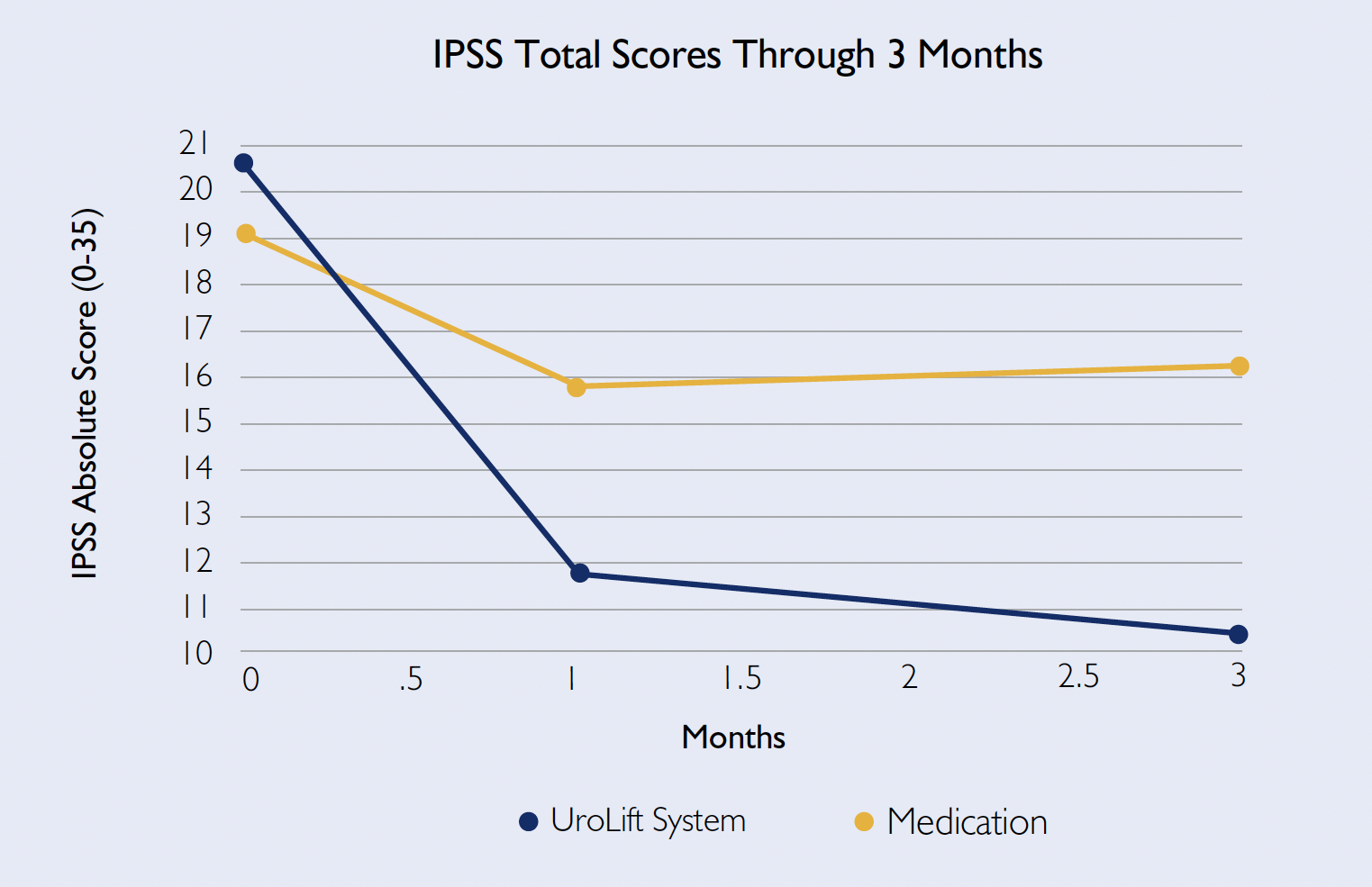
UroLift™ System PUL patients experienced improvements of 8.6 and 10 in IPSS total score at 1 and 3 months, respectively, compared to 3.4 and 3.1 for medication.29
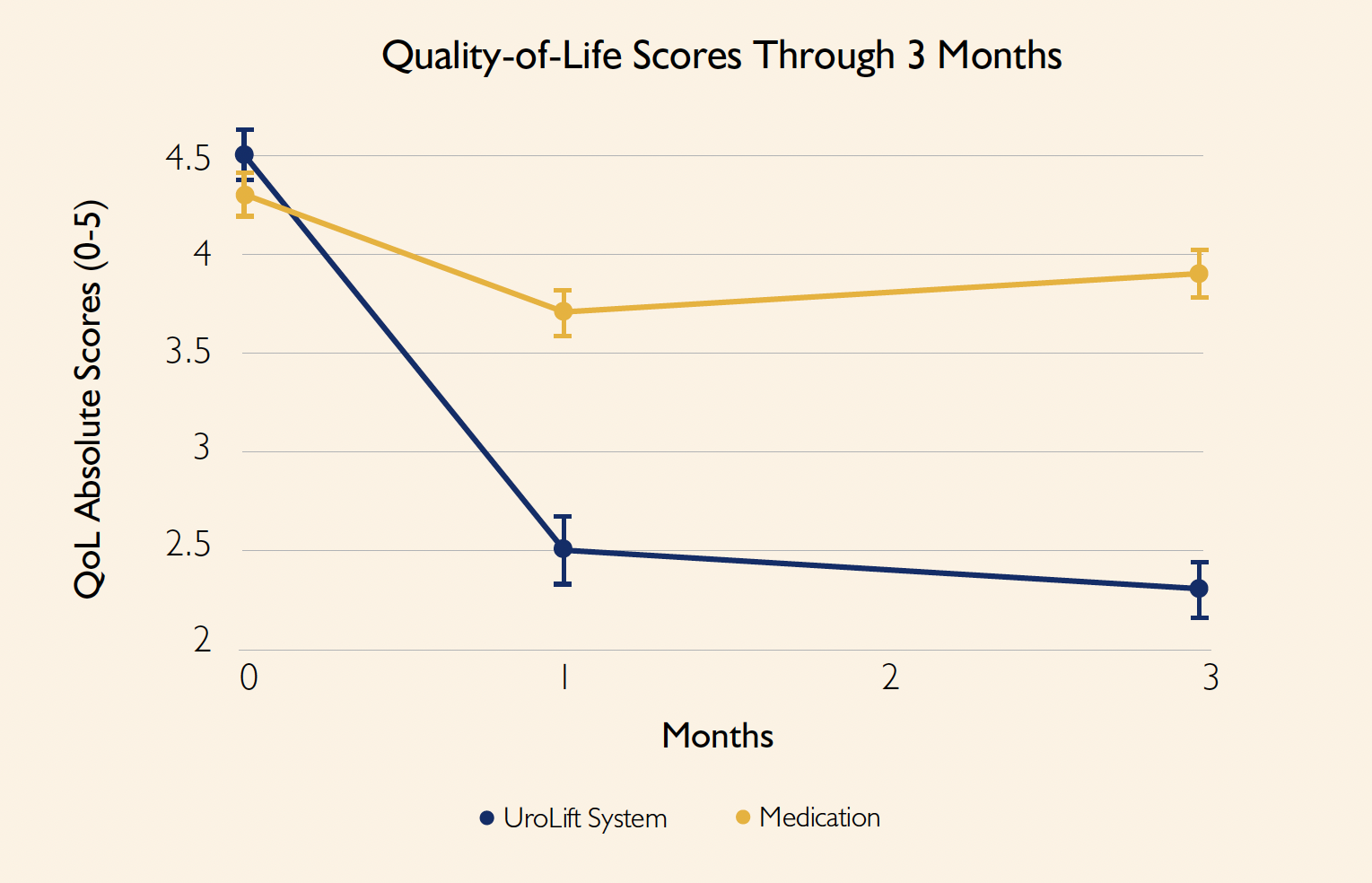
UroLift™ System PUL QoL scores improved 2.0 (39.3%) and 2.2 (47.9%) vs. 0.6 (10.2%) and 0.5 (7.8%) for medication at 1 and 3 months.29
Despite technological innovation, only 2% of men seeing a doctor for BPH are treated with a surgical intervention1
Traditional invasive surgery like TURP has been the gold standard BPH treatment since the 1920's. Newer technology has been introduced over the years to help improve patient experience factors such as long-term recovery, post-op complications and ejaculatory dysfunction.

UroLift™ System
Market leading minimally invasive BPH procedure1
Grade 3+ or Serious Adverse Events:
0.7%2
—
Sexual Function:
0% EjD**2

TURP
Traditional invasive surgery since 1926
Grade 3+ or Serious Adverse Events:
7.619-20
–
Sexual Function:
36% EjD**19-20

Aquablation
Robotic waterjet ablation comparable to traditional invasive surgeries
Grade 3+ or Serious Adverse Events:
6.9%19-20
—
Sexual Function:
10% EjD**19-20
The graphic is for educational purposes only. Direct comparisons of studies cannot be made.
**De novo ED or EjDamong sexually active men
The Only Leading BPH MIST With Consistent Durability in Real World and Clinical Trials2,3
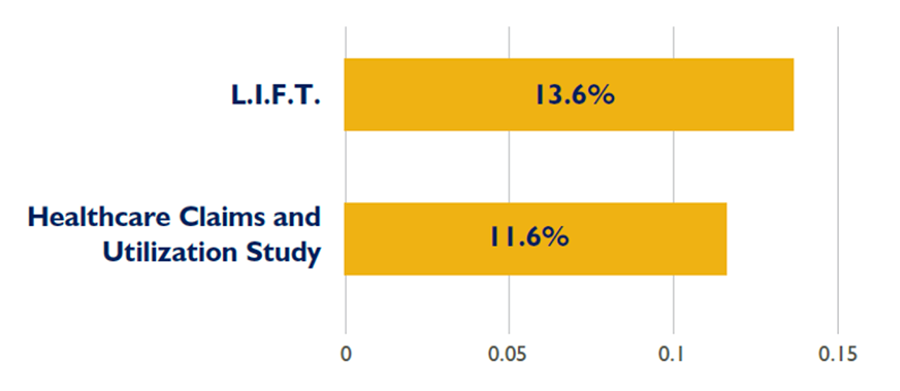
In a recent real-world analysis, the UroLift™ System demonstrated a comparable 5-year retreatment rate to the rate shown in the L.I.F.T. RCT (11.6% and 13.6%).2,3
Across clinical trials and real-world studies, the UroLift™ System has demonstrated largely consistent IPSS outcomes.2,21
5-year surgical retreatment rate vs. L.I.F.T. RCT surgical retreatment rate2,3
1 in 20
Did you know? New data shows that within one year of BPH surgery, 1 in 20 patients may require retreatment regardless of the procedure type.3
Hello, and welcome to A Decade in Leading BPH Care, How the UroLift System Continues to Deliver Consistent Durability with a superior patient experience. My name is Matt Ashley, Associate Medical Director at Teleflex Interventional Urology and a practicing urologist in Bend, Oregon. I'm excited to bring the urologic community together today to discuss BPH care, the current procedural landscape, and how we are harnessing large healthcare databases to better inform our patients as they navigate their BPH journey. Sharing the stage with me today will be Doctor. Stephen Kaplan, Professor of Urology at Mount Sinai School of Medicine and Director of the Mount Sinai Men's Wellness Program. He's an internationally renowned authority and thought leader in all aspects of BPH with over one thousand publications to his name, including numerous landmark studies within the field. I will also be joined by Doctor. Raj Shinghal, the Chairman of Urology at Palo Alto Medical Foundation. He completed his residency at Stanford University, where he has also served as teaching faculty. Raj practices general urology with a focus on BPH and stone disease and has participated in several clinical trials for novel BPH and stone treatments along with his leading research in large healthcare databases. BPH is a complex disease and we continue to uncover new facets. It's not just dealing with prostate obstruction, but the consequences that it has on the bladder, the role of the nervous system, the impact of numerous other medical conditions and patient behaviors that ultimately manifest themselves as the patient's lower urinary tract symptoms. However, even with all this new understanding of the disease complexity, we are still generally using a very narrow definition of success. And what's more, we will see how that narrow definition tends to poorly fit our patients' goals and expectations. We all strive to deliver on our patients' goals, but we first need to ask ourselves, how well do we understand what they actually want? The slide in front of you shows two separate studies that were done, one among patients and one among physicians. On the left side, you see a study of one thousand men with symptomatic BPH who were considering treatment and were asked to list their top priorities in BPH treatment. You can see their top four answers here included minimal downtime, minimal discomfort, no catheter, and preservation of sexual function. A very similar study was done among two hundred urologists who were asked to list their top priorities when offering BPH treatment. Their top four responses were durability, improvement of flow rate and emptying, improve irritative symptoms, and minimize variability in outcomes. So you can see here that in both of these surveys, the top four outcomes have no crossover whatsoever. So with that, the next question for us to ask ourselves is where does this disparity come from in patient and physician goals? Much of it comes from the way that BPH surgery has been developed and the fact that for decades there was really just one transurethral option. It's understandable that our goals and priorities would be set with that one procedure in mind. However, now that treatment options have expanded significantly, we have not seen the expansion in understanding patient priorities and goals that one would expect with the increased options. We now have the technology to deliver patient centered treatment. We just need to start offering. In this new BPH landscape, we have the opportunity to present diverse options for BPH treatment, you can see an expanded list of the men's health survey on the left. So this expands on the patient's priorities that you saw on the previous slide. These are the same values with which the UroLift system was originally developed and the fundamental vision that UroLift strives to keep at the forefront of its current mission and continued innovation. We as physicians face the challenge of balancing these priorities along with procedural risks and all in the context of the need for bladder protection. It's a complex discussion and one that our presentations this evening will help inform. We have seen some encouraging evolution in the AUA guidelines on BPH over the past few years with the recognition of the risks of medical treatment, the importance of discussing sexual side effects of treatment, and the need for anatomical evaluation with cystoscopy and prostate sizing. However, these do not go far enough. We still have work to do in order to fully align patient and physician priorities into the new paradigm of BPH care. I'd now like to welcome our two speakers. First, Doctor. Shing Hong, who will be speaking on Understanding BPH Treatment Device Safety in the FDA's MOD Database, followed by Doctor. Kaplan, who will be discussing Retreatment Rates and Post Procedural Complications After BPH surgery, a US healthcare claims and utilization study. Great. Thank you, Matt, for the introduction, and thank you, Teleflex, for this opportunity to speak to the urology community. Most importantly, thank you all for taking your own precious time to learn a little bit more about minimally invasive treatment options for BPH and their safety profile. My name is Raj Shingal. I'm a urologist practicing in Northern California at an organization called Palo Alto Medical Foundation. I'm in clinically active practice and take care of a variety of different issues, including BPH. My talk today is going to focus on understanding BPH treatment device safety in the FDA's MOD database. Over the years, we've looked at minimally invasive treatments for BPH from different perspectives, one of them being safety. Safety is paramount, do no harm as a surgeon and as a physician. The FDA's MOD database is a collection of malfunctions and injuries submitted to the FDA by both mandatory as well as voluntary reporters. The database is a valuable source of real world information regarding patient experience and device safety. Now, people have used the MAWD database in a variety of analyses. In the most recent analyses that have been published and even got some attention at the AUA, they looked at the raw number of events that were reported in the MAW database. Well, sure, you can do that. But if you don't understand the context of how often a particular procedure is performed, it really gives you a flawed picture. And the fundamental flaw of all these analyses is that they never accounted for the rate of complications or reports that were reported to the MAW database. So the analysis I'm going to present today looks at the number and severity of these BPH treatment medical device reports, or let's call them adverse events that are reported in MAWD. This is the first such analysis to place these entries in the context of total procedures performed annually. To do this, we performed a search of the MAUD database. You can log in and check the MAUD database out if you're really bored. You can use the terms UroLift, Rezum and AquaBeam for the entries between twenty nineteen and twenty twenty two. The entries were then adjudicated by yours truly, where we looked at event timing and severity. We then decided if these were intraoperative events and use something called the Gupta scale, which I'll review with you to adjudicate them in terms of severity. And then postoperative events were adjudicated using something called the Klaviyan Dindo scale, which I'm sure you're familiar with. We eliminated any duplicate or irrelevant entries. And the unique part of this analysis was that we created a market model to understand how often these procedures were being performed using both Medicare data as well as CPT codes between the period of twenty nineteen and twenty twenty two. The Gupta scale, which is on the left, is used for intraoperative events. Mild events are things that wouldn't cause any significant deviation from the planned procedure. Perhaps a device that didn't initially work and you were able to get it to work or something like that. Moving on to a life threatening event where a device caused serious harm, let's say a laser misfiring and causing an operative fire or something like that. The Klavian Dindo scale is on the other hand, a classification tool used in medicine to understand postoperative complications. And I think you're well familiar with this. Again, complications can be very mild where you had to give some Tylenol for a fever or something like that, the way to life threatening complications or even things that lead to patient death in grade four or grade five. There are even subclassifications within Clavian dindo, but we try to keep it simple and just use, grades one through five. So I wanna look at our market model and look at the number of procedures performed and the number of adverse events that were reported in mod. Let's look at the bottom table first. This looks at how often each procedure was performed in the periods between twenty nineteen and twenty twenty two. You can see that consistently, the Uralis system was performed, four times more often than the ReZoom procedure and eight times more often than AquaBlation over the period that we analyzed. Consistently sixty thousand to seventy thousand, UroLift procedures are performed annually in the United States. Aqua ablation did have an increase in the number of procedures from twenty nineteen through twenty twenty two. And I think you're probably seeing that more machines are being deployed in different areas and a whole lot of marketing around that. Now let's look at the figure in the upper right corner that looks at the number of adverse events or MDR submitted between between, in this period of time. You can see that in general, there has been a trend up in terms of the number of medical device reports. Although the UroLift numbers have stayed relatively stable, we do see a higher number of resume and higher number of AquaBlation numbers overall. Let's talk a little bit about that market model that gave you those numbers you saw on the last slide. This is something that we designed and we wanted to validate it. So first of all, how did we get the numbers for the market model? For UroLift procedures, we got those from Teleflex. For AquaBlation, we actually got those numbers from the Procept analysts and securities reports that are publicly available between two thousand twenty and two thousand twenty two. For the small number of procedures performed in twenty nineteen, those were imputed from a random sample of Medicare and commercial claims from Symphony Health. Rezum was a bit more challenging, but we were able to get those numbers again from a US Medicare and commercial claims, database and be able to impute those numbers into our model. To validate this, we actually compared this to externally validated databases that have been published. Some of you may be familiar with, including NISQIP, the Definitive Health Database and TriNet. Now two thirds of the BPH procedures performed in the United States are TURST, still ends up being a popular procedure. But one third of all procedures for BPH are UroLift procedures. You can see there's still a very small number of Rezum and AquaBlation procedures relative to UroLift overall. It was nice to see that the model we created really, paralleled what you could see in these three independent databases. So let's turn to the results from our analysis. What did we find when we actually look at the rates of complications? Well, let's start with the intraoperative events, the Gupta mild to moderate events. And what you can see is that UroLift outperforms Rezum and aqua ablation by an order of magnitude with only eight events per ten thousand procedures in two thousand nineteen and five events per ten thousand procedures in two thousand twenty two. Aqua ablation in the other hand is quite different with four percent intraoperative complication rates in twenty nineteen and one percent or one per one hundred in twenty twenty two, a very different type of procedure. Let's talk a little bit about the, more, severe events, the grade three or grade four events that could occur intraoperatively. Again, we see that opcoagulation performs quite differently compared to, procedures like UroLift or in this case Rezum. No severe or life threatening intraoperative events were reported with UroLift, or with Rezum versus aquablation. You can see that there were some high grade events that did occur that potentially could be life threatening. Now to be fair, aquablation is a maximally invasive procedure for for the prostate. This is not a minimally invasive procedure, but let's not kid ourselves. Although it really sounds nice when you're using a water jet to shave out the prostate, this is still a surgical procedure that potentially can have some complications. How about postoperative events? So looking at the mild clavio dindo events, using this scale, we can see that the rate of mild to moderate events for UroLift was stable over the period that we analyzed and was lower for UroLift, again, compared to resume or aquablation. The UroLift rate of events was two per ten thousand events from two thousand nineteen and continued that way all the way through two thousand twenty two. In fact, the rate went down a little bit, which may to more familiarity and more expertise across the community in doing UroLift procedures. I think we just get better at it as we've continued to do UroLift procedures. Rezum, on the other hand, you see four events approximately per one thousand procedures. So an order of magnitude higher and aquablation as well, you're seeing about four events per one hundred procedures initially when they weren't doing bladder neck cautery and now four events per one thousand procedures in twenty twenty two. Aquablation and its defense has gotten safer. Now that we are integrating focal bladder neck cautery, you are seeing less bleeding compared to the days when we just used traction. What about the more serious, grade three plus events? Again, here we're seeing the difference between a maximally invasive procedure versus minimally invasive procedures like UroLift. Fifteen percent of the patients experienced a serious postoperative event, reoperation, hemorrhage, transfusions, things like that. Those occurred in aquablation at fifteen percent of the reported procedures in twenty nineteen. In twenty twenty two, again, due to advances in technique, we're seeing that that number improves, but it's nowhere near what you're going to be seeing for something like UroLift or even Rezum. Again, maximally invasive versus a minimally invasive procedure. So what can we learn from this analysis? When you factor in procedure volume, UroLift has the lowest rates of mild, moderate and severe complications in both the intraoperative setting as well as the postoperative setting. And I just want to emphasize how important it is to look at the rates of complications. I mentioned how the mod database and analyses over the last couple AUAs had been published and even made the late breaking session. Those are looking at raw numbers and they drew some really flawed conclusions. If you look at things in the context of how many UroLift procedures are performed or how many Rezum procedures are performed, UroLift clearly has the best safety profile. Aqua ablation has improved over time, but it is a maximally invasive procedure that has more significant moderate and severe events compared to the minimally invasive procedures that we've mentioned today. I wanna thank you for your time and to continue on the theme of safety, Doctor. Kaplan is going to go ahead and deliver his talk. Thank you very much. Thank you to the Teleflex group and my fellow speakers to be able to have this opportunity to share some, I think important information and an important way of looking at the way we look at various types of therapies for lower urinary tract symptoms secondary to BPH. So one of the things that patients always kind of ask us is what the retreatment rates are going to be and what the likelihood of I'm going to need something else done. And we thought it's important to be able to share real world experiences because ultimately that's going to determine and really dictate the information that we actually get. So we worked together with Teleflex over the last couple of years and have presented some of the initial data and subsequent data to various meetings, the AUA and EAU. I'm kind of very happy to share some of this data with you. It was just published in prostate cancer and prostatic diseases. And it represents to date the largest real world experience with these various procedures. And again I'm going to say this over and over again it's important with respect to sharing this information with regards to expectations because most of what we share and we're good at sharing what the patient can expect on the day of the procedure, what's going to happen probably for the first day or two, maybe even the first month. But long term data is really based on registration data and that's the best of the best. And ultimately we kind of have all learned that what happens in the real world doesn't always reflect that. So we wanted to get a true reflection of what's actually going on in the real world and being able to present that to your patients as well. So a huge database was examined and this represents all Medicare and commercial claims. We didn't pull out and push out. It's everybody, all comers, between twenty fifteen and twenty twenty one. So everybody got thrown into the blender, as the case may be. We looked at outpatient claims and then men with a BPH diagnosis. And we looked at both invasive surgical procedures and we looked at specifically TURP and green light and also minimally invasive therapies. And we looked at prostatic urethral lift and water vapor thermotherapy. And these are the the main ones that we actually looked at. But in addition, what we wanted to do is to make sure that because a potential critique of this analysis would be, well maybe you kind of took different populations. Maybe one group was more likely to have sicker patients or different morbidities. So we did what we term hazard model risks to determine whether or not that was a factor in the data. And I'll share all this data with you shortly. So this represents again the largest real world data experience with invasive surgery and minimally invasive surgery for BPH, for lorreotide tract symptoms secondary to BPH. So here is the first big piece of data. And this represents the rate of procedural complications through ninety days and three sixty five days for the four procedures and ninety day and three sixty five days. And you can see that the cumulative one year rate is much higher in the Rezum water vapor thermotherapy than followed by GreenLight, TURP, and UroLift. It's interesting as you absorb this data in terms of your own experiences whether this kind of fits. Now one of the critiques potentially is that well you know ninety day it may be post procedural right away what's occurring. Catheters can come in, catheters can come out, irrigating a Foley catheter. Okay, that would be fine. One could argue that that would happen probably within the first thirty days. But let's just say that for a moment that that is true. We did three sixty five days. And there's no way, no way that we can say that it was the day of the procedure and immediate complications that occur right afterwards. And that three sixty five days is stunning, stunning with respect to the differences between the various procedures and is significantly higher in ReZeroom water vapor thermotherapy. So that's the first thing that kind of blasted out at us is like wow, more than I thought, higher than I thought. We also looked at the risk of enduring these procedural enduring procedural complications. And specifically as I alluded to before, we did this hazard model risk ratio to look at whether or not there were other factors that could have swayed the data in a way that biased it one way or another. In other words, was there more morbidity in one patient? Were there more diabetic patients, more obese patients, more hypertensive patients, age, all of that. All of that was kind of analyzed but we wanted to make sure that we weren't biasing the data even inappropriately or inadvertently towards one or the other. And you can see here that the data pretty much stayed the same. So specifically you can see these comparisons and we did in the first you can see green light versus TUR, resume versus green light, etc. So I'm going to pull out some statistically significant major data points. One, it was twenty three percent higher in TURP versus UroLift for static urethral lift. It was thirty three percent higher for GreenLight versus prostatic urethral lift. But it was sixty three percent higher in Rezum water vapor therapy versus UroLift prostatic urethral lift. And this is kind of across the board. So no matter how we sliced and diced the data, no matter how we looked at it and tried to really almost put an arm behind our back to try to see that but not missing something and doing that, the data clearly demonstrates significant differences between the three other procedures versus prostatic urethral lithium. Those are the numbers and I'll let it sit there for you to absorb it. This was highly significant, statistically significant. So this is real and it demonstrates that at least with these four procedures that prostatic urethral lift has a lower risk of encountering a procedural complication compared to the other four. So is one could argue what is really the best way of retreatment? And we can have this debate over and over again because some people will say, well if you're on a medication after a therapy is that a retreatment? Good argument. If you have to have procedures afterwards whether it's another catheterization, catheter irrigation, intravenous antibiotic after a procedure, anything, you could say, well, that could be part of the equation. But one thing you can't argue about is if you need something else done, another surgery. I mean, that is as clean a definition as you can do. I mean you cannot debate that. You can't argue that. I don't think anybody would argue that. So if you look at the numbers, and this to me was also fairly stunning, is what the rates of surgical retreatments were for the first year. And remember, this is everybody is in here. We didn't pull out some, we didn't delete others. This is every patient who had the Rezum water vapor thermotherapy, green light, TURP and prostatic urethral lift. And if you look at the rates of surgical retreatments, you can see that it's highest in the Rezum water vapor thermotherapy. But look at the TURP and the green light and I would bet that you would be surprised at that number. I was a little surprised. But the more you think about it, it actually maybe is not surprising in terms of what those numbers actually are. And it gives you a good table setting for how minimally invasive therapy as a whole should be viewed, I mean the class of minimally invasive therapies as you looked at the surgical retreatments for Rezum water vapor thermotherapy and UroLift, but also surgery. I mean surgery has a pretty significant retreatment rate in the first year. And I think that's kind of important to know and maybe some some folks didn't actually think about that or realize that. So I think for me that was kind of the stunning kind of take home points. Now this is five year data, so we didn't want to just look at one year, but we wanted to look at five year. And one of the critiques could be, well why didn't you put in Rezum water vapor thermotherapy? And we specifically did it because we didn't want to bias the data against Rezum water vapor therapy because it just wasn't enough clean data for five years because it came out later than prostatic urethral lift and certainly TURP and green light. So we purposely did not want to bias it particularly if we couldn't be confident in the number of patients that we could actually have and therefore we took that out of the mix in this analysis at five years, not one year but at five years. Because we want to introduce a sampling bias. So look at the rates of surgical retreatment. So for TUR, it's about seven percent, for green light about nine percent, and from a static urethral lift slightly higher at eleven point six percent. So a lot of messaging here. One is at least when I was training and I'm teaching, I thought that the surgical retreatment rate for TURP is about one percent per year. And you can see a lot of that is in the first year, maybe related to the need to go back in and retur the patient. But you can see five years it's about seven percent. So it's a little bit higher, it's about one point two percent, one point four percent per year. Green light is more. Again, not terribly surprising because probably in your own experiences you may have had to do more retreatments if you've seen them. One of the operations that I do a fair amount of is in patients who have failed green light prostatic vaporization. And prostatic urethral lift, a minimally invasive device, a minimally invasive procedure, is not that much higher. I mean, it's only about eleven percent. And again, that's fairly consistent with what we see with the registration data. So A, that kind of gives confidence about the registration data because if you look at the random control trials, it was thirteen point six percent and the real world was actually even better. And maybe it has to do with more people doing it and doing more of them and there's an experience and a training. And over time certainly I do them differently than I did with my first, having done hundreds of these now. And I do them differently. So I learned and maybe got like any other procedure, I got better at it as time went on. But those are the real numbers. And now you can tell a patient with confidence that that's the likelihood that you're going to need something else done. And particularly here with prostatic urethral lid. I think it has to be defined as we get more data in the future for Rezum water vapor thermotherapy. And obviously there are other things coming out like iTind and Optilum and we'll see what the real world is. But what's nice, at least here, is that at five year the registration data, the published registration data and real world data kind of lined up. So that was kind of a nice thing to see but again remember the one year and the five year data and remember some of the highlights of the data that we talked about before. So what's kind of the takeaways? And the take home message is not just for you but to be able to share with your patients as well. Within one year of BPH surgery, about one in twenty patients may require a retreatment whether they receive any of the four procedures that were analyzed. So that's important to know. From my perspective, that to me is something that I think patients would accept and would find reasonable. But now you can have real data to show that. At one year, the surgical retreatment weight is not statistically different between the therapies. You saw the numbers before, but nevertheless there are some slight differences but not statistically significant. At five years the retreatment rate for prostatic urethral lift is comparable to the published registration trials. While the five year retreatment rates for TURP and green light, I think are a little higher than expected based on traditional teaching. And I think that's important to know as well as you put this into the armamentarium for choices. And for some technologies, as we saw here, particularly the Rezum water vapor thermotherapy, as many as one in four may require procedural retreatment for a complication within the first year. So those are real numbers that I think will help you, not just in terms of yourself, how you align all these procedures. But for the first time we really had, I mean it's not a small database. This is everybody database. Everything is thrown into here between the assigned times. And again, we wanted to make sure that we had enough numbers to be able to make reasonable analyses which is why we didn't look at, as I said, resume water vapor thermotherapy at five years because we didn't have enough numbers. We didn't look at aqua ablation obviously it wasn't around. We didn't look at home because it's just a number of numbers. And we wanted to have enough numbers to be able to make reasonable assessments and conclusions. So again, thank you very much for your time and listening. And I hope this data is helpful as you put this all together. And you're gonna see more and more real world data. And I think that's where, if you will, the money is because that's what you'll be able to share with your patients and be able to use this in your own conversations as you think about what treatments you wanna use in the future. And I hope you find these types of analyses helpful to you and your practice. Again, thank you very much for your time. Thank you, Doctor. Kaplan and Shengla for sharing your research and insights. Before we go into questions from the audience, I'd like to make a few closing remarks. These two studies provided fascinating insights into the postoperative experience of patients undergoing various BPH treatments. When we think about the disconnect between patients and physicians, this is where we find some of the biggest differences in priorities. I use this data routinely in my own practice when explaining various procedural options in order to empower my patients to make decisions that fit their own unique values and priorities. It's not my job to decide what is important to any given patient, but it is my responsibility to communicate the most accurate picture of risks and benefits so they can choose what is right for them. So, understanding the reality of the post op experience and complication rates in a real world setting is crucial to that task. In my pre procedural discussion, I try to focus on issues that are important to the patient, and we can see from the large scale surveys that this is often speed of recovery, avoiding sexual side effects, avoiding catheters, and overall level of discomfort. Of course, is always balanced with an emphasis on preservation of bladder health and data driven assessments of procedural retreatment rates in the context of both controlled and real world data sets. By better recognizing our patients' concerns and providing realistic explanations of outcomes, we will move closer to bridging the gap between patient and physician priorities and move a step closer to the new paradigm in BPH care. We will now open up the presentation to questions from the audience.
Real-World Durability Analysis
Note: This webinar counts toward continuing education requirements for the UroLift™ System Center of Excellence program. To receive credit for watching the webinar, please view in UroLift University.
Provides Superior Patient Experience*
Among Leading BPH Procedures3-5

Rapid relief with a low risk profile22-23

Lowest catheter rate of the leading BPH procedures2,23-27

Preservation of sexual function***2
Patient Safety
Once procedure volume is factored in, the UroLift™ System has the lowest rates of mild, moderate, and severe complications on a per case basis from 2019-202228
The UroLift™ System had the lowest post-procedural complication rate at one year compared to other procedures.3
Hello, and welcome to A Decade in Leading BPH Care, How the UroLift System Continues to Deliver Consistent Durability with a superior patient experience. My name is Matt Ashley, Associate Medical Director at Teleflex Interventional Urology and a practicing urologist in Bend, Oregon. I'm excited to bring the urologic community together today to discuss BPH care, the current procedural landscape, and how we are harnessing large healthcare databases to better inform our patients as they navigate their BPH journey. Sharing the stage with me today will be Doctor. Stephen Kaplan, Professor of Urology at Mount Sinai School of Medicine and Director of the Mount Sinai Men's Wellness Program. He's an internationally renowned authority and thought leader in all aspects of BPH with over one thousand publications to his name, including numerous landmark studies within the field. I will also be joined by Doctor. Raj Shinghal, the Chairman of Urology at Palo Alto Medical Foundation. He completed his residency at Stanford University, where he has also served as teaching faculty. Raj practices general urology with a focus on BPH and stone disease and has participated in several clinical trials for novel BPH and stone treatments along with his leading research in large healthcare databases. BPH is a complex disease and we continue to uncover new facets. It's not just dealing with prostate obstruction, but the consequences that it has on the bladder, the role of the nervous system, the impact of numerous other medical conditions and patient behaviors that ultimately manifest themselves as the patient's lower urinary tract symptoms. However, even with all this new understanding of the disease complexity, we are still generally using a very narrow definition of success. And what's more, we will see how that narrow definition tends to poorly fit our patients' goals and expectations. We all strive to deliver on our patients' goals, but we first need to ask ourselves, how well do we understand what they actually want? The slide in front of you shows two separate studies that were done, one among patients and one among physicians. On the left side, you see a study of one thousand men with symptomatic BPH who were considering treatment and were asked to list their top priorities in BPH treatment. You can see their top four answers here included minimal downtime, minimal discomfort, no catheter, and preservation of sexual function. A very similar study was done among two hundred urologists who were asked to list their top priorities when offering BPH treatment. Their top four responses were durability, improvement of flow rate and emptying, improve irritative symptoms, and minimize variability in outcomes. So you can see here that in both of these surveys, the top four outcomes have no crossover whatsoever. So with that, the next question for us to ask ourselves is where does this disparity come from in patient and physician goals? Much of it comes from the way that BPH surgery has been developed and the fact that for decades there was really just one transurethral option. It's understandable that our goals and priorities would be set with that one procedure in mind. However, now that treatment options have expanded significantly, we have not seen the expansion in understanding patient priorities and goals that one would expect with the increased options. We now have the technology to deliver patient centered treatment. We just need to start offering. In this new BPH landscape, we have the opportunity to present diverse options for BPH treatment, you can see an expanded list of the men's health survey on the left. So this expands on the patient's priorities that you saw on the previous slide. These are the same values with which the UroLift system was originally developed and the fundamental vision that UroLift strives to keep at the forefront of its current mission and continued innovation. We as physicians face the challenge of balancing these priorities along with procedural risks and all in the context of the need for bladder protection. It's a complex discussion and one that our presentations this evening will help inform. We have seen some encouraging evolution in the AUA guidelines on BPH over the past few years with the recognition of the risks of medical treatment, the importance of discussing sexual side effects of treatment, and the need for anatomical evaluation with cystoscopy and prostate sizing. However, these do not go far enough. We still have work to do in order to fully align patient and physician priorities into the new paradigm of BPH care. I'd now like to welcome our two speakers. First, Doctor. Shing Hong, who will be speaking on Understanding BPH Treatment Device Safety in the FDA's MOD Database, followed by Doctor. Kaplan, who will be discussing Retreatment Rates and Post Procedural Complications After BPH surgery, a US healthcare claims and utilization study. Great. Thank you, Matt, for the introduction, and thank you, Teleflex, for this opportunity to speak to the urology community. Most importantly, thank you all for taking your own precious time to learn a little bit more about minimally invasive treatment options for BPH and their safety profile. My name is Raj Shingal. I'm a urologist practicing in Northern California at an organization called Palo Alto Medical Foundation. I'm in clinically active practice and take care of a variety of different issues, including BPH. My talk today is going to focus on understanding BPH treatment device safety in the FDA's MOD database. Over the years, we've looked at minimally invasive treatments for BPH from different perspectives, one of them being safety. Safety is paramount, do no harm as a surgeon and as a physician. The FDA's MOD database is a collection of malfunctions and injuries submitted to the FDA by both mandatory as well as voluntary reporters. The database is a valuable source of real world information regarding patient experience and device safety. Now, people have used the MAWD database in a variety of analyses. In the most recent analyses that have been published and even got some attention at the AUA, they looked at the raw number of events that were reported in the MAW database. Well, sure, you can do that. But if you don't understand the context of how often a particular procedure is performed, it really gives you a flawed picture. And the fundamental flaw of all these analyses is that they never accounted for the rate of complications or reports that were reported to the MAW database. So the analysis I'm going to present today looks at the number and severity of these BPH treatment medical device reports, or let's call them adverse events that are reported in MAWD. This is the first such analysis to place these entries in the context of total procedures performed annually. To do this, we performed a search of the MAUD database. You can log in and check the MAUD database out if you're really bored. You can use the terms UroLift, Rezum and AquaBeam for the entries between twenty nineteen and twenty twenty two. The entries were then adjudicated by yours truly, where we looked at event timing and severity. We then decided if these were intraoperative events and use something called the Gupta scale, which I'll review with you to adjudicate them in terms of severity. And then postoperative events were adjudicated using something called the Klaviyan Dindo scale, which I'm sure you're familiar with. We eliminated any duplicate or irrelevant entries. And the unique part of this analysis was that we created a market model to understand how often these procedures were being performed using both Medicare data as well as CPT codes between the period of twenty nineteen and twenty twenty two. The Gupta scale, which is on the left, is used for intraoperative events. Mild events are things that wouldn't cause any significant deviation from the planned procedure. Perhaps a device that didn't initially work and you were able to get it to work or something like that. Moving on to a life threatening event where a device caused serious harm, let's say a laser misfiring and causing an operative fire or something like that. The Klavian Dindo scale is on the other hand, a classification tool used in medicine to understand postoperative complications. And I think you're well familiar with this. Again, complications can be very mild where you had to give some Tylenol for a fever or something like that, all the way to life threatening complications or even things that lead to patient death in grade four or grade five. There are even subclassifications within Clavian dindo, but we try to keep it simple and just use, grades one through five. So I wanna look at our market model and look at the number of procedures performed and the number of adverse events that were reported in mod. Let's look at the bottom table first. This looks at how often each procedure was performed in the periods between twenty nineteen and twenty twenty two. You can see that consistently, the Uralis system was performed, four times more often than the ReZoom procedure and eight times more often than AquaBlation over the period that we analyzed. Consistently sixty thousand to seventy thousand, UroLift procedures are performed annually in the United States. Aqua ablation did have an increase in the number of procedures from twenty nineteen through twenty twenty two. And I think you're probably seeing that more machines are being deployed in different areas and a whole lot of marketing around that. Now let's look at the figure in the upper right corner that looks at the number of adverse events or MDR submitted between between, in this period of time. You can see that in general, there has been a trend up in terms of the number of medical device reports. Although the UroLift numbers have stayed relatively stable, we do see a higher number of resume and higher number of AquaBlation numbers overall. Let's talk a little bit about that market model that gave you those numbers you saw on the last slide. This is something that we designed and we wanted to validate it. So first of all, how did we get the numbers for the market model? For UroLift procedures, we got those from Teleflex. For AquaBlation, we actually got those numbers from the Procept analysts and securities reports that are publicly available between two thousand twenty and two thousand twenty two. For the small number of procedures performed in twenty nineteen, those were imputed from a random sample of Medicare and commercial claims from Symphony Health. Rezum was a bit more challenging, but we were able to get those numbers again from a US Medicare and commercial claims, database and be able to impute those numbers into our model. To validate this, we actually compared this to externally validated databases that have been published. Some of you may be familiar with, including NISQIP, the Definitive Health Database and TriNet. Now two thirds of the BPH procedures performed in the United States are TURST, still ends up being a popular procedure. But one third of all procedures for BPH are UroLift procedures. You can see there's still a very small number of Rezum and AquaBlation procedures relative to UroLift overall. It was nice to see that the model we created really, paralleled what you could see in these three independent databases. So let's turn to the results from our analysis. What did we find when we actually look at the rates of complications? Well, let's start with the intraoperative events, the Gupta mild to moderate events. And what you can see is that UroLift outperforms Rezum and aqua ablation by an order of magnitude with only eight events per ten thousand procedures in two thousand nineteen and five events per ten thousand procedures in two thousand twenty two. Aqua ablation in the other hand is quite different with four percent intraoperative complication rates in twenty nineteen and one percent or one per one hundred in twenty twenty two, a very different type of procedure. Let's talk a little bit about the, more, severe events, the grade three or grade four events that could occur intraoperatively. Again, we see that opcoagulation performs quite differently compared to, procedures like UroLift or in this case Rezum. No severe or life threatening intraoperative events were reported with UroLift, or with Rezum versus aquablation. You can see that there were some high grade events that did occur that potentially could be life threatening. Now to be fair, aquablation is a maximally invasive procedure for for the prostate. This is not a minimally invasive procedure, but let's not kid ourselves. Although it really sounds nice when you're using a water jet to shave out the prostate, this is still a surgical procedure that potentially can have some complications. How about postoperative events? So looking at the mild clavio dindo events, using this scale, we can see that the rate of mild to moderate events for UroLift was stable over the period that we analyzed and was lower for UroLift, again, compared to resume or aquablation. The UroLift rate of events was two per ten thousand events from two thousand nineteen and continued that way all the way through two thousand twenty two. In fact, the rate went down a little bit, which may to more familiarity and more expertise across the community in doing UroLift procedures. I think we just get better at it as we've continued to do UroLift procedures. Rezum, on the other hand, you see four events approximately per one thousand procedures. So an order of magnitude higher and aquablation as well, you're seeing about four events per one hundred procedures initially when they weren't doing bladder neck cautery and now four events per one thousand procedures in twenty twenty two. Aquablation and its defense has gotten safer. Now that we are integrating focal bladder neck cautery, you are seeing less bleeding compared to the days when we just used traction. What about the more serious, grade three plus events? Again, here we're seeing the difference between a maximally invasive procedure versus minimally invasive procedures like UroLift. Fifteen percent of the patients experienced a serious postoperative event, reoperation, hemorrhage, transfusions, things like that. Those occurred in aquablation at fifteen percent of the reported procedures in twenty nineteen. In twenty twenty two, again, due to advances in technique, we're seeing that that number improves, but it's nowhere near what you're going to be seeing for something like UroLift or even Rezum. Again, maximally invasive versus a minimally invasive procedure. So what can we learn from this analysis? When you factor in procedure volume, UroLift has the lowest rates of mild, moderate and severe complications in both the intraoperative setting as well as the postoperative setting. And I just want to emphasize how important it is to look at the rates of complications. I mentioned how the mod database and analyses over the last couple AUAs had been published and even made the late breaking session. Those are looking at raw numbers and they drew some really flawed conclusions. If you look at things in the context of how many UroLift procedures are performed or how many Rezum procedures are performed, UroLift clearly has the best safety profile. Aqua ablation has improved over time, but it is a maximally invasive procedure that has more significant moderate and severe events compared to the minimally invasive procedures that we've mentioned today. I wanna thank you for your time and to continue on the theme of safety, Doctor. Kaplan is going to go ahead and deliver his talk. Thank you very much. Thank you to the Teleflex group and my fellow speakers to be able to have this opportunity to share some, I think important information and an important way of looking at the way we look at various types of therapies for lower urinary tract symptoms secondary to BPH. So one of the things that patients always kind of ask us is what the retreatment rates are going to be and what the likelihood of I'm going to need something else done. And we thought it's important to be able to share real world experiences because ultimately that's going to determine and really dictate the information that we actually get. So we worked together with Teleflex over the last couple of years and have presented some of the initial data and subsequent data to various meetings, the AUA and EAU. I'm kind of very happy to share some of this data with you. It was just published in prostate cancer and prostatic diseases. And it represents to date the largest real world experience with these various procedures. And again I'm going to say this over and over again it's important with respect to sharing this information with regards to expectations because most of what we share and we're good at sharing what the patient can expect on the day of the procedure, what's going to happen probably for the first day or two, maybe even the first month. But long term data is really based on registration data and that's the best of the best. And ultimately we kind of have all learned that what happens in the real world doesn't always reflect that. So we wanted to get a true reflection of what's actually going on in the real world and being able to present that to your patients as well. So a huge database was examined and this represents all Medicare and commercial claims. We didn't pull out and push out. It's everybody, all comers, between twenty fifteen and twenty twenty one. So everybody got thrown into the blender, as the case may be. We looked at outpatient claims and then men with a BPH diagnosis. And we looked at both invasive surgical procedures and we looked at specifically TURP and green light and also minimally invasive therapies. And we looked at prostatic urethral lift and water vapor thermotherapy. And these are the the main ones that we actually looked at. But in addition, what we wanted to do is to make sure that because a potential critique of this analysis would be, well maybe you kind of took different populations. Maybe one group was more likely to have sicker patients or different morbidities. So we did what we term hazard model risks to determine whether or not that was a factor in the data. And I'll share all this data with you shortly. So this represents again the largest real world data experience with invasive surgery and minimally invasive surgery for BPH, for lorreotide tract symptoms secondary to BPH. So here is the first big piece of data. And this represents the rate of procedural complications through ninety days and three sixty five days for the four procedures and ninety day and three sixty five days. And you can see that the cumulative one year rate is much higher in the Rezum water vapor thermotherapy than followed by GreenLight, TURP, and UroLift. It's interesting as you absorb this data in terms of your own experiences whether this kind of fits. Now one of the critiques potentially is that well you know ninety day it may be post procedural right away what's occurring. Catheters can come in, catheters can come out, irrigating a Foley catheter. Okay, that would be fine. One could argue that that would happen probably within the first thirty days. But let's just say that for a moment that that is true. We did three sixty five days. And there's no way, no way that we can say that it was the day of the procedure and immediate complications that occur right afterwards. And that three sixty five days is stunning, stunning with respect to the differences between the various procedures and is significantly higher in ReZeroom water vapor thermotherapy. So that's the first thing that kind of blasted out at us is like wow, more than I thought, higher than I thought. We also looked at the risk of enduring these procedural enduring procedural complications. And specifically as I alluded to before, we did this hazard model risk ratio to look at whether or not there were other factors that could have swayed the data in a way that biased it one way or another. In other words, was there more morbidity in one patient? Were there more diabetic patients, more obese patients, more hypertensive patients, age, all of that. All of that was kind of analyzed but we wanted to make sure that we weren't biasing the data even inappropriately or inadvertently towards one or the other. And you can see here that the data pretty much stayed the same. So specifically you can see these comparisons and we did in the first you can see green light versus TUR, resume versus green light, etc. So I'm going to pull out some statistically significant major data points. One, it was twenty three percent higher in TURP versus UroLift for static urethral lift. It was thirty three percent higher for GreenLight versus prostatic urethral lift. But it was sixty three percent higher in Rezum water vapor therapy versus UroLift prostatic urethral lift. And this is kind of across the board. So no matter how we sliced and diced the data, no matter how we looked at it and tried to really almost put an arm behind our back to try to see that but not missing something and doing that, the data clearly demonstrates significant differences between the three other procedures versus prostatic urethral lithium. Those are the numbers and I'll let it sit there for you to absorb it. This was highly significant, statistically significant. So this is real and it demonstrates that at least with these four procedures that prostatic urethral lift has a lower risk of encountering a procedural complication compared to the other four. So is one could argue what is really the best way of retreatment? And we can have this debate over and over again because some people will say, well if you're on a medication after a therapy is that a retreatment? Good argument. If you have to have procedures afterwards whether it's another catheterization, catheter irrigation, intravenous antibiotic after a procedure, anything, you could say, well, that could be part of the equation. But one thing you can't argue about is if you need something else done, another surgery. I mean, that is as clean a definition as you can do. I mean you cannot debate that. You can't argue that. I don't think anybody would argue that. So if you look at the numbers, and this to me was also fairly stunning, is what the rates of surgical retreatments were for the first year. And remember, this is everybody is in here. We didn't pull out some, we didn't delete others. This is every patient who had the Rezum water vapor thermotherapy, green light, TURP and prostatic urethral lift. And if you look at the rates of surgical retreatments, you can see that it's highest in the Rezum water vapor thermotherapy. But look at the TURP and the green light and I would bet that you would be surprised at that number. I was a little surprised. But the more you think about it, it actually maybe is not surprising in terms of what those numbers actually are. And it gives you a good table setting for how minimally invasive therapy as a whole should be viewed, I mean the class of minimally invasive therapies as you looked at the surgical retreatments for Rezum water vapor thermotherapy and UroLift, but also surgery. I mean surgery has a pretty significant retreatment rate in the first year. And I think that's kind of important to know and maybe some some folks didn't actually think about that or realize that. So I think for me that was kind of the stunning kind of take home points. Now this is five year data, so we didn't want to just look at one year, but we wanted to look at five year. And one of the critiques could be, well why didn't you put in Rezum water vapor thermotherapy? And we specifically did it because we didn't want to bias the data against Rezum water vapor therapy because it just wasn't enough clean data for five years because it came out later than prostatic urethral lift and certainly TURP and green light. So we purposely did not want to bias it particularly if we couldn't be confident in the number of patients that we could actually have and therefore we took that out of the mix in this analysis at five years, not one year but at five years. Because we want to introduce a sampling bias. So look at the rates of surgical retreatment. So for TUR, it's about seven percent, for green light about nine percent, and from a static urethral lift slightly higher at eleven point six percent. So a lot of messaging here. One is at least when I was training and I'm teaching, I thought that the surgical retreatment rate for TURP is about one percent per year. And you can see a lot of that is in the first year, maybe related to the need to go back in and retur the patient. But you can see five years it's about seven percent. So it's a little bit higher, it's about one point two percent, one point four percent per year. Green light is more. Again, not terribly surprising because probably in your own experiences you may have had to do more retreatments if you've seen them. One of the operations that I do a fair amount of is in patients who have failed green light prostatic vaporization. And prostatic urethral lift, a minimally invasive device, a minimally invasive procedure, is not that much higher. I mean, it's only about eleven percent. And again, that's fairly consistent with what we see with the registration data. So A, that kind of gives confidence about the registration data because if you look at the random control trials, it was thirteen point six percent and the real world was actually even better. And maybe it has to do with more people doing it and doing more of them and there's an experience and a training. And over time certainly I do them differently than I did with my first having done hundreds of these now and I do them differently. So I learned and maybe got like any other procedure, I got better at it as time went on. But those are the real numbers. And now you can tell a patient with confidence that that's the likelihood that you're going to need something else done. And particularly here with prostatic urethral lid. I think it has to be defined as we get more data in the future for Rezum water vapor thermotherapy. And obviously there are other things coming out like iTind and Optilum and we'll see what the real world is. But what's nice, at least here, is that at five year the registration data, the published registration data and real world data kind of lined up. So that was kind of a nice thing to see but again remember the one year and the five year data and remember some of the highlights of the data that we talked about before. So what's kind of the takeaways? And the take home message is not just for you but to be able to share with your patients as well. Within one year of BPH surgery, about one in twenty patients may require a retreatment whether they receive any of the four procedures that were analyzed. So that's important to know. From my perspective, that to me is something that I think patients would accept and would find reasonable. But now you can have real data to show that. At one year, the surgical retreatment weight is not statistically different between the therapies. You saw the numbers before, but nevertheless there are some slight differences but not statistically significant. At five years the retreatment rate for prostatic urethral lift is comparable to the published registration trials. While the five year retreatment rates for TURP and green light, I think are a little higher than expected based on traditional teaching. And I think that's important to know as well as you put this into the armamentarium for choices. And for some technologies, as we saw here, particularly the Rezum water vapor thermotherapy, as many as one in four may require procedural retreatment for a complication within the first year. So those are real numbers that I think will help you, not just in terms of yourself, how you align all these procedures. But for the first time we really had, I mean it's not a small database. This is everybody database. Everything is thrown into here between the assigned times. And again, we wanted to make sure that we had enough numbers to be able to make reasonable analyses which is why we didn't look at, as I said, resume water vapor thermotherapy at five years because we didn't have enough numbers. We didn't look at aqua ablation obviously it wasn't around. We didn't look at home because it's just a number of numbers. And we wanted to have enough numbers to be able to make reasonable assessments and conclusions. So again, thank you very much for your time and listening. And I hope this data is helpful as you put this all together. And you're gonna see more and more real world data. And I think that's where, if you will, the money is because that's what you'll be able to share with your patients and be able to use this in your own conversations as you think about what treatments you wanna use in the future. And I hope you find these types of analyses helpful to you and your practice. Again, thank you very much for your time. Thank you, Doctor. Kaplan and Shengla for sharing your research and insights. Before we go into questions from the audience, I'd like to make a few closing remarks. These two studies provided fascinating insights into the postoperative experience of patients undergoing various BPH treatments. When we think about the disconnect between patients and physicians, this is where we find some of the biggest differences in priorities. I use this data routinely in my own practice when explaining various procedural options in order to empower my patients to make decisions that fit their own unique values and priorities. It's not my job to decide what is important to any given patient, but it is my responsibility to communicate the most accurate picture of risks and benefits so they can choose what is right for them. So, understanding the reality of the post op experience and complication rates in a real world setting is crucial to that task. In my pre procedural discussion, I try to focus on issues that are important to the patient, and we can see from the large scale surveys that this is often speed of recovery, avoiding sexual side effects, avoiding catheters, and overall level of discomfort. Of course, is always balanced with an emphasis on preservation of bladder health and data driven assessments of procedural retreatment rates in the context of both controlled and real world data sets. By better recognizing our patients' concerns and providing realistic explanations of outcomes, we will move closer to bridging the gap between patient and physician priorities and move a step closer to the new paradigm in BPH care. We will now open up the presentation to questions from the audience.
MAUDE Study: Patient Safety
Note: This webinar counts toward continuing education requirements for the UroLift™ System Center of Excellence program. To receive credit for watching the webinar, please view in UroLift University.
Learn More About the UroLift™ System Procedure and the Latest Data
References
1. U.S. 2022 estimates based on US Market Model 2022-24 (5-17-22 FINAL), which is in part based on Symphony Health PatientSource® 2018-21, as is and with no representations/ warranties, including accuracy or completeness.
2. Roehrborn, Can J Urol 2017
3. Kaplan, Prostate Cancer Prostatic Dis 2023
4. Gratzke, BJU Int 2016
5. Tutrone, Can J Urol 2020
6. McConnell, NEJM 2003
7. AUA BPH Guidelines, 2003, 2010
8. Chang DF, Campbell JR, J Cataract Refract Surg. 2005 Apr; 31(4): 664-673
9. Lai et al, CMAJ. 2016 Mar 01; 188(4): 255-260
10. Duan et al, Pharmacoepidemiol Drug Saf. 2018 Mar; 27(3): 340-348
11. Welk et al, JAMA Intern Med. 2017 May 1; 177(5): 683-691
12. Traish et al, Horm Mol Biol Clin Investig. 2017 Jun 21; 30(3): 1-16
13. Wei et al, BMJ. 2019 Apr 10; 365:I12049
14. Welk et al, J Neurol Sci. 2017 Aug 15; 379: 109-111
15. S. Diviccaro, et al. Neurobiology of Stress 12 2020
16. Lusty, J Urol 2021
17. Cindolo, Eur Urol 2015
18. Young et al. The Changing Practice of Transurethral Resection of the Prostate, Ann. R. Coll Surg England, 2018
19. Gilling, Can J Urol 2022
20. Gilling, J Urol 2018
21. Eure, J Endourol 2019
22. Roehrborn, J Urol 2013
23. Shore, Can J Urol 2014
24. Bachmann, Eur Urol 2013
25. McVary, J Urol 2016
26. Mollengarden, Prostate Cancer Prostatic Dis 2018
27. Das, Can J Urol 2019
28. Shinghal R, Ashley M, Eure G (2023). Total Procedural Context is Crucial in Understanding BPH Treatment Device Safety in the FDA’s MAUDE Database. (Manuscript in preparation)
29. Roehrborn, et al, AUA 2024. Preliminary RCT Analysis of Minimally Invasive Surgery vs. Medication in the Initial Treatment of BPH-Associated LUTS. AUA Study sponsored by Teleflex Incorporated or its affiliates.
*Patient experience defined as a combination of rapid symptom relief, low risk profile, and preservation of sexual function
**De novo ED or EjD among sexually active men
***No instances of new, sustained erectile or ejaculatory dysfunction in the L.I.F.T. pivotal study
+While the MAUDE Database is a powerful resource, it is subject to certain limitations. These include the potential for underreporting of adverse events and the variability in the quality and consistency of the information reported. MAUDE data does not represent all known safety information for a reported medical device and should be interpreted in the context of other available information when making device-related or treatment decisions.
MAC02843-01 Rev A


